• This is slide 1 description. Go to Edit HTML of your blogger blog. Find these sentences. You can replace these sentences with your own words.
  • This is slide 2 description. Go to Edit HTML of your blogger blog. Find these sentences. You can replace these sentences with your own words.
  • This is slide 3 description. Go to Edit HTML of your blogger blog. Find these sentences. You can replace these sentences with your own words.
  • This is slide 4 description. Go to Edit HTML of your blogger blog. Find these sentences. You can replace these sentences with your own words.
  • This is slide 5 description. Go to Edit HTML of your blogger blog. Find these sentences. You can replace these sentences with your own words.

Tuesday, 28 May 2019

Black stork

Black stork.
The black stork (Ciconia nigra) is a large bird in the stork family, Ciconiidae. It was first described by Carl Linnaeus in the 10th edition of his Systema Naturae. Measuring on average 95 to 100 cm (37 to 39 in) from beak tip to end of tail with a 145-to-155 cm (57-to-61 in) wingspan, the adult black stork has mainly black plumage, with white underparts, long red legs and a long pointed red beak. A widespread, but uncommon, species, it breeds in scattered locations across Europe (predominantly in Spain, and central and eastern Europe) and Asia. It is a long-distance migrant, with European populations wintering in tropical Sub-Saharan Africa, and Asian populations in the Indian subcontinent. Unlike the closely related white stork, the black stork is a shy and wary species. It is seen singly or in pairs, usually in marshy areas, rivers or inland waters. It feeds on amphibians, small fish and insects, generally wading slowly in shallow water to stalk its prey.


Monday, 27 May 2019

Arthur Mold

Arthur Mold.
Arthur Mold (27 May 1863 – 29 April 1921) was an English professional cricketer. He began his cricket career playing for Banbury and Northamptonshire in the mid-1880s, then played first-class cricket for Lancashire as a fast bowler between 1889 and 1901. A Wisden Cricketer of the Year in 1892, he was selected for England in three Test matches in 1893. Mold was one of the most effective bowlers in England during the 1890s but his career was overshadowed by controversy over his bowling action; many critics thought he threw rather than bowled the ball. He was penalised in 1900 and 1901 by the umpire Jim Phillips, who had targeted several prominent bowlers with dubious bowling actions. Although Mold took 1,673 wickets in first-class matches, many commentators viewed his achievements as tainted. After his departure from the game, throwing ceased to be a concern in English cricket for 50 years.

Sunday, 26 May 2019

History of Aston Villa F.C. (1961–present)

History of Aston Villa F.C. (1961–present).
The history of Aston Villa F.C. since 1961 includes a European Cup victory in 1982 and a loss in the 2018 EFL Championship play-off Final. After a change of ownership and management for the club and successive relegations, they returned in the 1971–72 season to the Second Division as champions with a record 70 points. In 1974 Ron Saunders was appointed manager, and by 1975 he had led the club back into the First Division and into European competition. The club won the league in the 1980–81 season, and the European Cup final in the next season. They were one of the founding members of the Premier League in 1992, and finished runners-up to Manchester United in the inaugural season. They reached the FA Cup Final for the first time since 1957 in 2000. The arrival of a new manager and Randy Lerner as owner in 2006 marked the start of sweeping changes throughout the club. After several years of narrowly avoiding the drop, Villa were relegated at the end of the 2015–16 season.

Saturday, 25 May 2019

Crawford expedition

Crawford expedition.
The Crawford expedition was a campaign on the western front of the American Revolutionary War, and one of the final operations of the conflict. Led by Colonel William Crawford (pictured), the campaign began May 25, 1782. Its goal was to destroy American Indian towns along the Sandusky River in the Ohio Country, with the hope of ending attacks on American settlers. The expedition was one in a long series of raids that both sides had conducted against enemy settlements throughout the war. Crawford led about 500 volunteer militiamen, mostly from Pennsylvania. The Indians and their British allies from Detroit gathered a force and surrounded the Americans. Seventy were killed, including Crawford, who was tortured and executed, probably in retaliation for the Gnadenhutten massacre two months earlier. Indian and British losses were minimal, and the rest of the Americans escaped and found their way back to Pennsylvania.

Friday, 24 May 2019

Ashton-under-Lyne

Ashton-under-Lyne.
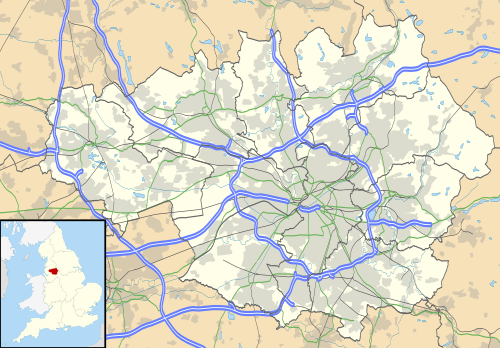
Ashton-under-Lyne is a market town in Tameside, Greater Manchester, England. The population was 45,198 at the 2011 census. Historically in Lancashire, it is on the north bank of the River Tame, in the foothills of the Pennines, 6.2 miles (10.0 km) east of Manchester. "Ashton", deriving from Old English for "settlement by ash trees", probably dates from the Anglo-Saxon period. In the Middle Ages, Ashton-under-Lyne was a parish and township and Ashton Old Hall was held by the de Asshetons, lords of the manor. Granted a Royal Charter in 1414, the manor spanned a rural area of marshland, moorland, villages and hamlets. By the mid-19th century Ashton had emerged as an important mill town at a convergence of newly constructed canals and railways. The transport network allowed for an economic boom in cotton spinning, weaving, and coal mining, which led to the granting of municipal borough status in 1847.

Thursday, 23 May 2019

Donner Party

Donner Party.
The Donner Party was a group of American pioneers who set out for California in a wagon train. Delayed by a series of mishaps, they were snowbound in the Sierra Nevada mountain range from November 1846 to February 1847. Some of the emigrants resorted to cannibalism to survive, eating the bodies of those who had succumbed to starvation and sickness. The journey west usually took between four and six months, but the Donner Party had been slowed by following a new route called the Hastings Cutoff across Utah's Wasatch Mountains and the Great Salt Lake Desert. They lost many cattle and wagons in the rugged terrain, and divisions formed within the group. Their food supplies ran low after they became trapped by an early, heavy snowfall high in the mountains. In mid-December some of the group set out on foot and were able to obtain help. Of the 87 members of the party, 48 survived to reach California. Historians have described the episode as one of the most spectacular tragedies in California history.

Wednesday, 22 May 2019

Cortinarius violaceus

Cortinarius violaceus.
Cortinarius violaceus, the violet webcap, is a fungus found predominantly in conifer forests in North America and deciduous forests in Europe. The fruit bodies are dark purple mushrooms with caps up to 15 cm (6 in) across, sporting gills underneath. The stalk measures 6 to 12 centimetres (2 1⁄3 to 4 2⁄3 in) by 1 to 2 centimetres (3⁄8 to 3⁄4 in), sometimes with a thicker base. The dark flesh has a smell reminiscent of cedar wood. Though they are edible, the mushrooms' appearance is more distinctive than their taste. The species forms symbiotic (mycorrhizal) relationships with the roots of various plants. It was first described by Carl Linnaeus in 1753, and has undergone several name changes. Other populations once identified as C. violaceus or close to that species have now been described as new and separate species, such as C. palatinus, C. neotropicus, C. altissimus, C. kioloensis and C. hallowellensis.