• This is slide 1 description. Go to Edit HTML of your blogger blog. Find these sentences. You can replace these sentences with your own words.
  • This is slide 2 description. Go to Edit HTML of your blogger blog. Find these sentences. You can replace these sentences with your own words.
  • This is slide 3 description. Go to Edit HTML of your blogger blog. Find these sentences. You can replace these sentences with your own words.
  • This is slide 4 description. Go to Edit HTML of your blogger blog. Find these sentences. You can replace these sentences with your own words.
  • This is slide 5 description. Go to Edit HTML of your blogger blog. Find these sentences. You can replace these sentences with your own words.

Sunday, 11 August 2019

European hare

European hare.
The European hare (Lepus europaeus) is one of the largest hare species. Native to Europe and parts of Asia, it is adapted to temperate, open country. Hares feed mainly on grasses and herbs, supplementing these with twigs, buds, bark and field crops, particularly in winter. They rely on high-speed endurance running to escape predators, including large birds of prey, canids and felids. Generally nocturnal and shy, hares can be seen in the spring in broad daylight chasing one another around in fields, and sometimes striking each other with their paws ("boxing"). The female nests in a depression on the surface of the ground, giving birth to three or four kits that are active as soon as they are born. The European hare has a wide range and is moderately abundant, but populations have been declining in mainland Europe since the 1960s. The hare has been a traditional symbol of fertility and reproduction in some cultures.
Saturday, 10 August 2019

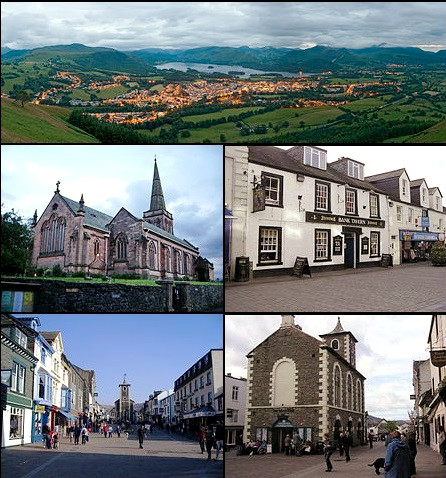
Keswick, Cumbria

Keswick, Cumbria.
Keswick, Cumbria, is an English market town and civil parish, historically in Cumberland, and since 1974 in the Borough of Allerdale. The town, in the Lake District National Park, just north of Derwentwater, and 4 miles (6.4 km) from Bassenthwaite, had a population of 4,821 at the time of the 2011 census. There is considerable evidence of prehistoric occupation of the Keswick area. The first recorded mention of the town dates from the 13th century, when Edward I granted a charter for Keswick's market, which has maintained a continuous 700-year existence. In Tudor times the town was an important mining area, and from the 18th century onwards it has increasingly been known as a holiday centre; tourism has been its principal industry for more than 150 years. Two of the Lake Poets, Samuel Taylor Coleridge and Robert Southey, lived in Keswick in the early 19th century and made the scenic beauty of the area widely known to readers in Britain and beyond.

Friday, 9 August 2019

Gadsden Purchase half dollar

Gadsden Purchase half dollar.
The Gadsden Purchase half dollar was a proposed commemorative coin to be issued by the United States Bureau of the Mint. El Paso coin dealer L. W. Hoffecker (pictured) wanted a coin issued he could control and distribute. He gained the support of several members of Congress, and a bill was introduced. Treasury Secretary Andrew W. Mellon sent a letter and two officials in opposition to the bill at its committee hearing, but it passed both houses of Congress without dissent. On April 21, 1930, President Herbert Hoover vetoed the bill, deeming commemorative coins abusive; the House of Representatives sustained his veto. No commemorative coins were struck during the remainder of the Hoover administration, and although they began again after Franklin D. Roosevelt was inaugurated, in 1938, Roosevelt vetoed one, citing Hoover's action, as would Truman and Eisenhower. No commemorative coins were struck from 1955 until after the Treasury Department changed its position in 1981.

Thursday, 8 August 2019