• This is slide 1 description. Go to Edit HTML of your blogger blog. Find these sentences. You can replace these sentences with your own words.
  • This is slide 2 description. Go to Edit HTML of your blogger blog. Find these sentences. You can replace these sentences with your own words.
  • This is slide 3 description. Go to Edit HTML of your blogger blog. Find these sentences. You can replace these sentences with your own words.
  • This is slide 4 description. Go to Edit HTML of your blogger blog. Find these sentences. You can replace these sentences with your own words.
  • This is slide 5 description. Go to Edit HTML of your blogger blog. Find these sentences. You can replace these sentences with your own words.

Saturday, 7 December 2019

Aquaria (video game)

Aquaria (video game).
Aquaria is a sidescrolling action-adventure game designed by Alec Holowka and Derek Yu, who published it independently in 2007. The game features the voice of Jenna Sharpe as Naija, an aquatic humanoid woman, as she explores the underwater world of Aquaria. The gameplay focuses on swimming, combat, and special songs that can move items, affect plants and animals, and change Naija's physical appearance. After more than two years of development, the game was first released in late 2007 for Windows, followed by ports for Macintosh, Linux, iPad and Android users. In 2009, an Aquaria soundtrack album was released. Reviews of the game were generally positive. Critics praised the visuals, music and atmosphere. The controls and gameplay were also lauded, while negative critiques centered on the map system and limited variety of objectives. The game won the Seumas McNally Grand Prize at the Independent Games Festival (pictured) in March 2007.
Friday, 6 December 2019

Hurricane Connie

Hurricane Connie.
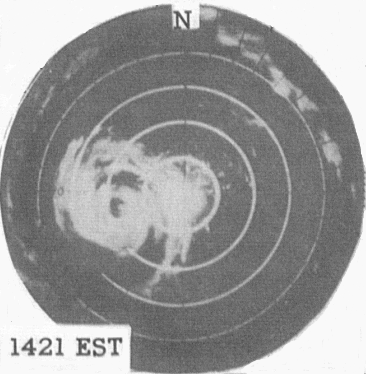
Hurricane Connie was the first of three hurricanes to strike North Carolina in 1955. It formed on August 3 in the eastern Atlantic Ocean, and killed three people in the United States Virgin Islands while passing nearby. Connie reached reported maximum sustained winds of 120 knots (140 mph, 220 km/h), making it a Category 4 hurricane, before it weakened and moved ashore on August 12. It tracked north through the Chesapeake Bay region, and was later absorbed by a cold front over Lake Huron on August 15. The hurricane caused around $86 million in damage, and at least 295,000 people nationwide lost power during the storm. In North Carolina, the storm killed 27 people. In the Chesapeake Bay, Connie capsized a boat, killing 14 people. There were also 4 deaths in Washington, D.C., 6 deaths each in New Jersey and Pennsylvania, 14 in New York, and 3 in Ontario. Connie was followed days later by Hurricane Diane, which caused $700 million in flood damage.

Thursday, 5 December 2019

Jacobus Anthonie Meessen

Jacobus Anthonie Meessen.
Jacobus Anthonie Meessen (5 December 1836 – 14 November 1885) was a Dutch photographer who took more than 250 portraits and landscapes in the Dutch East Indies (now Indonesia) between 1864 and 1870. He worked as a carpenter in the Indies before returning to the Netherlands in the early 1860s. Moving back to the colony in 1864, he documented its land and people, working mainly in Java and Sumatra. He also photographed Bangka, Belitung, Borneo, and Nias. When Meessen returned to the Netherlands in 1870 he went into partnership with Abraham Vermeulen and began disseminating his photographs. In 1871 he gave King William III an elaborately decorated album with selected images, now kept at the Royal Library of the Netherlands. Other photographs were published by J. H. De Bussy in 1875 and exhibited in Paris and Amsterdam. Collections of his albumen prints, some of which were hand-tinted or annotated, are held in four institutions in the Netherlands.

Wednesday, 4 December 2019

Sloan–Parker House

Sloan–Parker House.
The Sloan–Parker House is a late-18th-century stone residence near Junction, Hampshire County, in the U.S. state of West Virginia. It is located on the Northwestern Turnpike (US 50 and WV 28) in the rural Mill Creek valley. The original fieldstone section of the house was erected around 1790 for Richard Sloan and his wife Charlotte Van Horn Sloan. The Sloan family operated a successful weaving business from the house, and their Sloan counterpanes (quilts with block-designs) became well known in the region. In 1854 the family sold the house and 900 acres (360 ha) to the Parker family, who operated a stagecoach line on the Moorefield and North Branch Turnpike; the journey included a stop at the house, where the family served meals to travelers. During the Civil War, both Union and Confederate forces visited the house, and it was ransacked by Union troops for goods and supplies. It was listed on the National Register of Historic Places in 1975.