• This is slide 1 description. Go to Edit HTML of your blogger blog. Find these sentences. You can replace these sentences with your own words.
  • This is slide 2 description. Go to Edit HTML of your blogger blog. Find these sentences. You can replace these sentences with your own words.
  • This is slide 3 description. Go to Edit HTML of your blogger blog. Find these sentences. You can replace these sentences with your own words.
  • This is slide 4 description. Go to Edit HTML of your blogger blog. Find these sentences. You can replace these sentences with your own words.
  • This is slide 5 description. Go to Edit HTML of your blogger blog. Find these sentences. You can replace these sentences with your own words.

Friday, 14 February 2020

Love It to Death

Love It to Death.
Love It to Death is the third studio album by the American rock band Alice Cooper (pictured), released in March 1971. The band took the name Alice Cooper in 1968 and became known for its outrageous theatrical live shows, but its first two albums failed to find an audience. In 1970 the band's single "I'm Eighteen" achieved top-forty success, peaking at No. 21 in the US and No. 7 in Canada. This convinced Warner Bros. that Alice Cooper had the commercial potential to release an album. Love It to Death reached No. 35 on the Billboard 200 albums chart and has since been certified platinum. In addition to "I'm Eighteen", a second track from the album, "Caught in a Dream", was released as a single and charted at No. 94 in the US. The album is seen as a foundational influence on hard rock, punk, and heavy metal. Several tracks have become live Alice Cooper standards and are frequently covered by other bands.
Thursday, 13 February 2020

The Unconquered (1940 play)

The Unconquered (1940 play).
The Unconquered is a three-act play written by Russian-American author Ayn Rand as an adaptation of her 1936 novel We the Living. Producer George Abbott staged the play on Broadway in February 1940, featuring Helen Craig (pictured) as Kira Argounova, a young woman living in the Soviet Union in the 1920s. Her lover Leo Kovalensky develops tuberculosis. To get money for his treatment, Kira has an affair with a Communist official, Andrei Taganov. After Leo recovers from his illness, he becomes involved with black market food sales that Andrei is investigating. When Andrei realizes that Kira loves Leo, he helps his rival avoid prosecution, then commits suicide. Leo leaves Kira, who decides to risk her life escaping the country. The production was troubled by problems with the script and the cast. When the play opened at the Biltmore Theatre, it was a critical and financial failure, and closed in less than a week. It was the last of Rand's plays produced during her lifetime.

Wednesday, 12 February 2020

Arthur Sullivan

Arthur Sullivan.
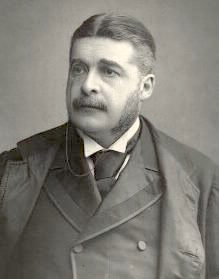
Arthur Sullivan (13 May 1842 – 22 November 1900) was an English composer best known for his operatic collaborations with the dramatist W. S. Gilbert. Among his early works were a ballet, a symphony, a cello concerto and a one-act comic opera, Cox and Box, which is still widely performed. He wrote his first opera with Gilbert, Thespis, in 1871. In 1875 the impresario Richard D'Oyly Carte engaged Gilbert and Sullivan to create a one-act piece, Trial by Jury. Its box-office success led the partners to collaborate on 12 more full-length comic operas, including H.M.S. Pinafore, The Pirates of Penzance and The Mikado. Sullivan's only grand opera, Ivanhoe, though initially successful in 1891, has rarely been revived. His works include 24 operas, 11 major orchestral works, 10 choral works and oratorios, 2 ballets, incidental music to several plays, and numerous church pieces, songs, and piano and chamber pieces. His hymns and songs include "Onward, Christian Soldiers" and "The Lost Chord".

Tuesday, 11 February 2020

Yeomanry Cavalry

Yeomanry Cavalry.
The Yeomanry Cavalry was the mounted component of the British Volunteer Corps, a military auxiliary established in the late 18th century. When the Volunteer Corps was disbanded after the defeat of Napoleon in 1815, the yeomanry – recruited from the middle and upper classes – was retained as a politically reliable institution that could act as a mounted police force. It became infamous after playing a leading part in the Peterloo Massacre of 1819, and its policing role declined as civilian police forces were established in the mid-19th century. The yeomanry struggled to find a place in the military establishment, and it survived largely because of its members' political influence and willingness to subsidise it financially. It found a new relevance when the Second Boer War revealed a need for mounted infantry. It was reorganised in 1901 as the Imperial Yeomanry, and in 1908 it ceased to be a discrete institution when all volunteer auxiliaries were amalgamated into the Territorial Force.