• This is slide 1 description. Go to Edit HTML of your blogger blog. Find these sentences. You can replace these sentences with your own words.
  • This is slide 2 description. Go to Edit HTML of your blogger blog. Find these sentences. You can replace these sentences with your own words.
  • This is slide 3 description. Go to Edit HTML of your blogger blog. Find these sentences. You can replace these sentences with your own words.
  • This is slide 4 description. Go to Edit HTML of your blogger blog. Find these sentences. You can replace these sentences with your own words.
  • This is slide 5 description. Go to Edit HTML of your blogger blog. Find these sentences. You can replace these sentences with your own words.

Thursday, 19 March 2020

Sonestown Covered Bridge
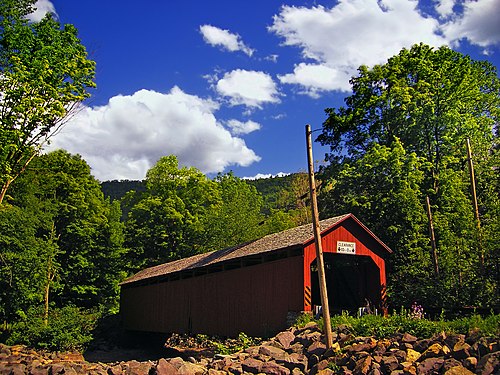
Sonestown Covered Bridge.
The Sonestown Covered Bridge is a Burr arch truss covered bridge over Muncy Creek in Davidson Township, Sullivan County, in the U.S. state of Pennsylvania. Built c. 1850, the bridge is 110 feet (34 m) long, and was placed on the National Register of Historic Places (NRHP) in 1980. The bridge is named for the nearby unincorporated village of Sonestown; it was built to provide access to a gristmill, which operated until the early 20th century. The bridge construction is cruder than the other two surviving covered bridges in Sullivan County, with each Burr arch formed from six straight beams set at angles instead of a smooth curve. Despite being repaired or restored several times from 1969, as of 2016 the bridge was deemed "deemed "basically intolerable requiring high priority of corrective action" on the National Bridge Inventory. It is the shortest covered bridge in the county and as of 2015 had average daily traffic of 50 vehicles.

Wednesday, 18 March 2020

Arnold Bax

Arnold Bax.
Arnold Bax (1883–1953) was an English composer, poet, and author. Best known for his orchestral music, he also wrote songs, choral music, chamber pieces, and solo piano works. In addition to a series of symphonic poems, he wrote seven symphonies, and was for a time widely regarded as the leading British symphonist. Bax was born in Streatham to a prosperous family who encouraged his music career, and his private income enabled him to follow his own path as a composer without regard for fashion or orthodoxy. While still a student at the Royal Academy of Music, Bax became fascinated with Ireland and the Celtic Revival. In the years before the First World War he lived in Ireland and became a member of Dublin literary circles, writing fiction and verse under the pseudonym Dermot O'Byrne. His best-known work is the symphonic poem Tintagel (1917). In 1942 Bax was appointed Master of the King's Music.

Tuesday, 17 March 2020

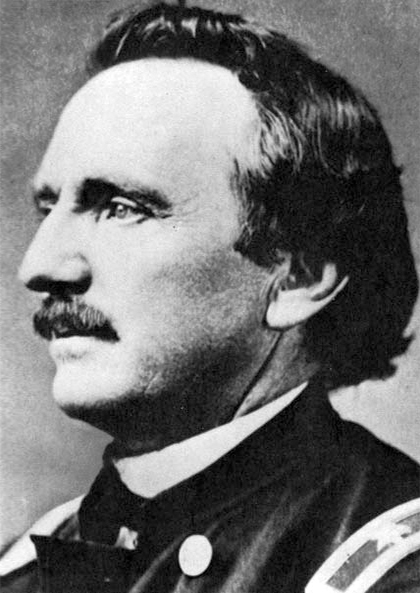
William F. Raynolds

William F. Raynolds.
William F. Raynolds (March 17, 1820 – October 18, 1894) was an explorer, engineer and army officer who served in the Mexican–American War and the American Civil War. He oversaw the construction of numerous lighthouses; at least six of them are still standing and in use. During the occupation of Mexico in 1848, Raynolds led a party that was the first to summit Pico de Orizaba, the highest mountain in Mexico and believed at that time to be the highest in North America. In 1859, Raynolds was placed in charge of the first government-sponsored expedition into the Yellowstone region. Heavy snowpack prevented the expedition from reaching the Yellowstone Plateau, forcing them to cross Union Pass in the Wind River Range. The expedition then entered Jackson Hole and surveyed the Teton Range, now within Grand Teton National Park. Raynolds retired from the army in 1884 with the rank of colonel after a 40-year career.

Monday, 16 March 2020

Bridgeport, Connecticut, Centennial half dollar

Bridgeport, Connecticut, Centennial half dollar.
The Bridgeport, Connecticut, Centennial half dollar is a fifty-cent piece issued by the United States Bureau of the Mint in 1936 as a commemorative coin. Designed by Henry Kreis, the obverse (pictured) depicts the showman P. T. Barnum, who was one of Bridgeport's most famous residents, mayor of the city, helped develop it, and is buried there. Bridgeport authorities wanted a commemorative coin, and authorizing legislation passed Congress without opposition. Kreis had designed the Connecticut Tercentenary half dollar (1935), and he produced designs showing Barnum and a modernistic eagle similar to the one on the Connecticut piece. The coins were vended to the public beginning in September 1936 at a price of $2. Too late for most of the centennial celebrations, the coins sold well. Unsold pieces were bought up by coin dealers and wholesale quantities were available on the secondary market until the 1970s. The Bridgeport half dollar sells in the low hundreds of dollars, depending on condition.