• This is slide 1 description. Go to Edit HTML of your blogger blog. Find these sentences. You can replace these sentences with your own words.
  • This is slide 2 description. Go to Edit HTML of your blogger blog. Find these sentences. You can replace these sentences with your own words.
  • This is slide 3 description. Go to Edit HTML of your blogger blog. Find these sentences. You can replace these sentences with your own words.
  • This is slide 4 description. Go to Edit HTML of your blogger blog. Find these sentences. You can replace these sentences with your own words.
  • This is slide 5 description. Go to Edit HTML of your blogger blog. Find these sentences. You can replace these sentences with your own words.

Saturday, 4 April 2020

Friday, 3 April 2020

Rodrigues starling

Rodrigues starling.
The Rodrigues starling (Necropsar rodericanus) is an extinct species of starling that was endemic to the Mascarene island of Rodrigues. Its closest relatives were the Mauritius starling and the hoopoe starling from nearby islands. The bird was reported by a French sailor Julien Tafforet, who was marooned on the island from 1725 to 1726. He observed it on the offshore islet of ÃŽle Gombrani. Subfossil remains (pictured) from the mainland were described in 1879, and suggested to be of the same species. Confusion about the bird and its taxonomic relations persisted through the 20th century. This starling was 25–30 centimetres (10–12 inches) long, and had a stout beak. It was described as having a white body, partially black wings and tail, and a yellow bill and legs. Little is known about its behaviour, although its diet included eggs and dead tortoises. Predation by rats introduced to the area was probably responsible for the bird's extinction some time in the 18th century, first on mainland Rodrigues, then on ÃŽle Gombrani.

Thursday, 2 April 2020

Hathor

Hathor.
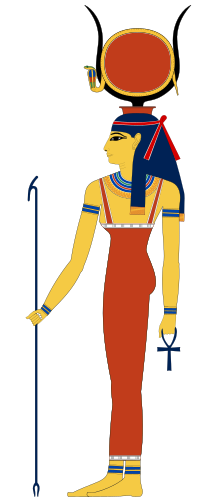
Hathor was a major goddess in ancient Egyptian religion. As a sky deity, she was the mother or consort of the sky god Horus and the sun god Ra, and the symbolic mother of their earthly representatives, the pharaohs. She was one of several goddesses who acted as the Eye of Ra, Ra's feminine counterpart, and in this form she had a vengeful aspect that protected him from his enemies. Her beneficent side represented music, dance, joy, love, sexuality and maternal care. These two aspects of the goddess exemplified the Egyptian conception of femininity. Hathor crossed boundaries between worlds, helping deceased souls in the transition to the afterlife. She was often depicted as a cow, although her most common form was a woman wearing a headdress of cow horns and a sun disk. More temples were dedicated to her than to any other goddess; her most prominent temple was Dendera. She was one of the deities commonly invoked in private prayers and votive offerings, particularly by women desiring children.

Wednesday, 1 April 2020

German battleship Tirpitz

German battleship Tirpitz.
Tirpitz was the second of two Bismarck-class battleships built for Nazi Germany during World War II. The ship was laid down in November 1936 and commissioned in February 1941. Tirpitz was armed with a main battery of eight 38-centimetre (15 in) guns in four twin turrets. She was the heaviest battleship ever built by a European navy. In early 1942, the ship sailed to Norway to act as a fleet in being, forcing the British navy to retain significant forces in the area. In September 1943, Tirpitz, along with the battleship Scharnhorst, bombarded Allied positions on Spitzbergen, the only time the ship's main battery was used offensively. On 12 November 1944, British Lancaster bombers equipped with 12,000-pound (5,400 kg) "Tallboys" bombed the ship, causing her to capsize. A deck fire spread to an ammunition magazine causing a large explosion. Between 1948 and 1957, the wreck was broken up in a salvage operation. (This article is part of a featured topic: Battleships of Germany.)