• This is slide 1 description. Go to Edit HTML of your blogger blog. Find these sentences. You can replace these sentences with your own words.
  • This is slide 2 description. Go to Edit HTML of your blogger blog. Find these sentences. You can replace these sentences with your own words.
  • This is slide 3 description. Go to Edit HTML of your blogger blog. Find these sentences. You can replace these sentences with your own words.
  • This is slide 4 description. Go to Edit HTML of your blogger blog. Find these sentences. You can replace these sentences with your own words.
  • This is slide 5 description. Go to Edit HTML of your blogger blog. Find these sentences. You can replace these sentences with your own words.

Sunday, 11 October 2020

Jerome, Arizona

Jerome, Arizona.
Jerome is a town in the Black Hills of Yavapai County in the U.S. state of Arizona. Founded in the late 19th century on Cleopatra Hill overlooking the Verde Valley, it is about 100 miles (160 km) north of Phoenix along State Route 89A between Sedona and Prescott. Supported in its heyday by mines, it was home to more than 10,000 people in the 1920s. The town owes its existence mainly to two ore bodies that formed about 1.75 billion years ago. In the late 19th century, the United Verde Mine, developed by William A. Clark, extracted ore bearing copper, gold, silver, and other metals from the larger of the two deposits. The United Verde Extension UVX Mine, owned by James Douglas Jr., worked the smaller one. The copper deposits discovered in the vicinity of Jerome were among the richest ever found. As the ore deposits ran out, the mines closed, and the population had dwindled to fewer than 100 by the mid-1950s. Jerome became a National Historic Landmark in 1967.
Saturday, 10 October 2020

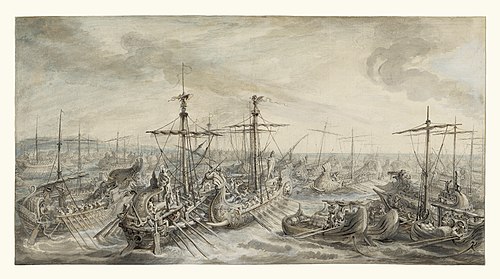
Battle of Cape Ecnomus

Battle of Cape Ecnomus.
The Battle of Cape Ecnomus was a naval battle fought off the coast of Sicily in 256 BC between the fleets of Carthage and the Roman Republic during the First Punic War (264–241 BC). The Carthaginian fleet was commanded by Hanno the Great and Hamilcar; the Roman fleet was led by the consuls for the year, Marcus Atilius Regulus and Lucius Manlius Vulso Longus. The Roman fleet of 330 warships sailed with approximately 140,000 men on board. The Romans' plan was to cross to Africa and invade the Carthaginian homeland, in what is now Tunisia. The Carthaginians were apparently aware of the Romans' intentions and mustered 350 warships off the south coast of Sicily to intercept them. With a combined total of about 680 warships carrying up to 290,000 crew and marines, the battle was possibly the largest naval battle in history by the number of combatants involved. After a prolonged and confused day of fighting the Carthaginians were decisively defeated.

Friday, 9 October 2020

Hassium

Hassium.
Hassium is a highly radioactive chemical element with symbol Hs and atomic number 108. The most stable known isotopes have half-lives of around 10 seconds. Natural occurrences of this superheavy element have been hypothesised, but none has ever been found. The first attempts to artificially prepare element 108 by nuclear fusion began in 1978 at the Joint Institute for Nuclear Research in the Soviet Union; though likely successful by 1984, these experiments did not prove conclusively that the element had been synthesised. For this reason, the discovery is principally credited to a team led by Peter Armbruster and Gottfried Münzenberg at the Gesellschaft für Schwerionenforschung who bombarded lead-208 with iron-58 and produced hassium-265. The name hassium was selected as a reference to the German state of Hesse, where the research was conducted. The observed chemical properties of hassium are consistent with its expected placement as the group 8 element in period 7 of the periodic table.

Thursday, 8 October 2020

Florin (British coin)

Florin (British coin).
The British florin, or two-shilling coin, was issued from 1849 until 1967, with a final issue for collectors dated 1970. Valued at one tenth of a pound (24 old pence), it was introduced in 1849 as part of an experiment in decimalisation that went no further at that time. The original florins attracted controversy for omitting a reference to God from Queen Victoria's titles; that type is accordingly known as the "godless florin", and was in 1851 succeeded by the "Gothic florin", for its design and style of lettering. Throughout most of its existence, the florin bore some variation of either the shields of the United Kingdom or the emblems of its constituent nations. In 1968, prior to Decimal Day, the Royal Mint began issuing the ten-pence piece, identical to the florin in specifications and value. Both coins remained in circulation until 1993, when the ten pence piece was made smaller, and the florin was demonetised.