• This is slide 1 description. Go to Edit HTML of your blogger blog. Find these sentences. You can replace these sentences with your own words.
  • This is slide 2 description. Go to Edit HTML of your blogger blog. Find these sentences. You can replace these sentences with your own words.
  • This is slide 3 description. Go to Edit HTML of your blogger blog. Find these sentences. You can replace these sentences with your own words.
  • This is slide 4 description. Go to Edit HTML of your blogger blog. Find these sentences. You can replace these sentences with your own words.
  • This is slide 5 description. Go to Edit HTML of your blogger blog. Find these sentences. You can replace these sentences with your own words.

Monday, 11 January 2021

Sunday, 10 January 2021

Siamosaurus

Siamosaurus.
Siamosaurus is a genus of spinosaurid dinosaur from what is now Thailand in the Early Cretaceous period. The first reported spinosaurid from Asia, it is confidently known only from tooth fossils (example pictured). The type species, Siamosaurus suteethorni (named for Thai palaeontologist Varavudh Suteethorn), was formally described in 1986. In 2009, four teeth from China previously attributed to a pliosaur were provisionally identified as possibly those of Siamosaurus. Siamosaurus's body length is uncertain, but has been estimated at 5.1 to 9.1 metres (17 to 30 feet). The teeth, typically 62.5 millimetres (2.46 inches) long, were conical and had longitudinal grooves and wrinkled enamel. It would have had a long, low snout and robust forelimbs, and possibly a sail down its back. Its teeth are similar to those of other spinosaurids, and it may not be a dinosaur at all. Its teeth were suitable for impaling rather than tearing, and it may have eaten fish, pterosaurs and small dinosaurs. It lived in a semi-arid habitat of floodplains and rivers.

Siamosaurus

Siamosaurus.
Siamosaurus is a genus of spinosaurid dinosaur from what is now Thailand in the Early Cretaceous period. The first reported spinosaurid from Asia, it is confidently known only from tooth fossils (example pictured). The type species, Siamosaurus suteethorni (named for Thai palaeontologist Varavudh Suteethorn), was formally described in 1986. In 2009, four teeth from China previously attributed to a pliosaur were provisionally identified as possibly those of Siamosaurus. Siamosaurus's body length is uncertain, but has been estimated at 5.1 to 9.1 metres (17 to 30 feet). The teeth, typically 62.5 millimetres (2.46 inches) long, were conical and had longitudinal grooves and wrinkled enamel. It would have had a long, low snout and robust forelimbs, and possibly a sail down its back. Its teeth are similar to those of other spinosaurids, and it may not be a dinosaur at all. Its teeth were suitable for impaling rather than tearing, and it may have eaten fish, pterosaurs and small dinosaurs. It lived in a semi-arid habitat of floodplains and rivers.

Saturday, 9 January 2021

Ficus macrophylla

Ficus macrophylla.
Ficus macrophylla, the Moreton Bay fig, is a large evergreen banyan tree of the family Moraceae native to eastern Australia. A strangler fig, it usually germinates in the canopy of a host tree and lives as an epiphyte until its roots establish contact with the ground; it then enlarges, reaching up to 60 m (200 ft) in height. The large leathery, dark green leaves are 15–30 cm (6–12 in) long. The fruit is small, round and greenish, ripening and turning purple at any time of year. Inverted inflorescences, with flowers lining an internal cavity, are pollinated only by fig wasps. Many bird species, including pigeons, parrots and various passerines, eat the fruit. Old specimens of F. macrophylla can reach tremendous size with imposing buttress roots, and the species is widely used as a feature tree in public parks and gardens in warmer climates. Its aggressive root system renders it unsuitable for all but the largest private gardens.

Friday, 8 January 2021

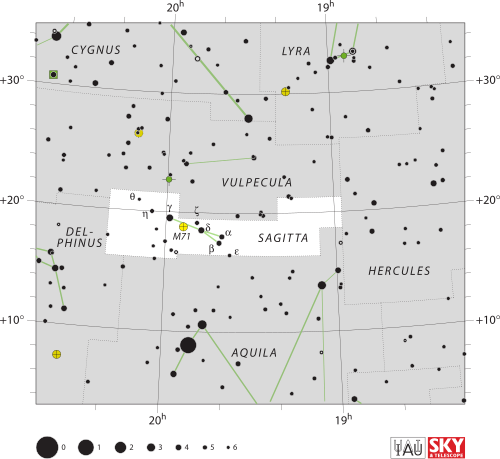
Sagitta

Sagitta.
Sagitta is a dim but distinctive constellation in the northern sky. Its name is Latin for 'arrow', and it should not be confused with the larger constellation Sagittarius, the archer. It was included among the 48 constellations listed by the 2nd-century astronomer Ptolemy, and it remains one of the 88 modern constellations defined by the International Astronomical Union. Although it dates from antiquity, Sagitta has no star brighter than 3rd magnitude and has the third-smallest area of any constellation. Gamma Sagittae is the constellation's brightest star, with an apparent magnitude of 3.47. Delta, Epsilon, Zeta and Theta Sagittae are each multiple stars whose components can be seen in small telescopes. Two star systems in Sagitta have Jupiter-like planets, while a third—15 Sagittae—has a brown dwarf companion. V Sagittae is a cataclysmic variable—a binary star system that is expected to go nova and briefly become one of the brightest stars in our sky around the year 2083.