• This is slide 1 description. Go to Edit HTML of your blogger blog. Find these sentences. You can replace these sentences with your own words.
  • This is slide 2 description. Go to Edit HTML of your blogger blog. Find these sentences. You can replace these sentences with your own words.
  • This is slide 3 description. Go to Edit HTML of your blogger blog. Find these sentences. You can replace these sentences with your own words.
  • This is slide 4 description. Go to Edit HTML of your blogger blog. Find these sentences. You can replace these sentences with your own words.
  • This is slide 5 description. Go to Edit HTML of your blogger blog. Find these sentences. You can replace these sentences with your own words.

Friday, 23 April 2021

Thursday, 22 April 2021

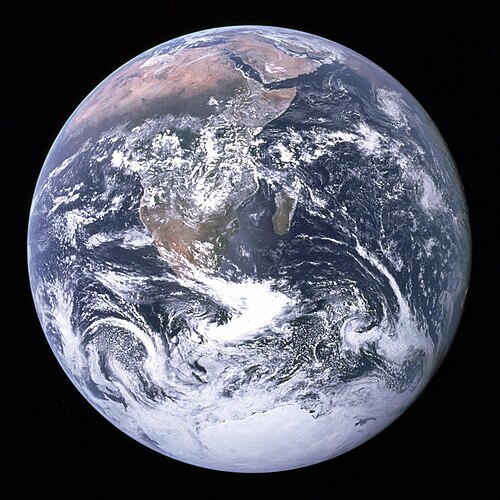
Earth

Earth.
Earth is the third planet from the Sun and the only astronomical object known to harbor life. It is the densest planet in the Solar System and the largest and most massive of the four rocky planets. About 29% of Earth's surface is land, with the remaining 71% covered with water and much of Earth's polar regions covered in ice. Earth's interior is active with a solid iron inner core, a liquid outer core that generates Earth's magnetic field, and a convective mantle that drives plate tectonics. Earth formed over 4.5 billion years ago. Within the first billion years of Earth's history, life appeared in the oceans and began to affect Earth's atmosphere and surface. Since then, the combination of Earth's distance from the Sun, physical properties and geological history have allowed life to evolve and thrive. Almost 8 billion humans live on Earth and depend on its biosphere and natural resources for their survival, but increasingly impact Earth's surface, atmosphere and other life. (This article is part of a featured topic: Solar System.)

Wednesday, 21 April 2021

Battle of the Saw

Battle of the Saw.
The Battle of the Saw was the culminating battle of a campaign fought between a Carthaginian army led by Hamilcar Barca and a rebel force led by Spendius in 238 BC in what is now northern Tunisia. Carthage was fighting a coalition of mutinous soldiers and rebellious African cities in the Mercenary War which had started in 240 BC. Unable to confront the Carthaginian war elephants and cavalry on open ground, the rebels stayed on higher and rougher terrain and harassed the Carthaginian army. After several months of campaigning, Hamilcar trapped the rebels. Pinned against the mountains, with their supply lines blockaded and with their food exhausted, the rebels ate their horses, their prisoners and then their slaves, hoping that their comrades in Tunis would sortie to rescue them. Eventually, the Carthaginians, led by their elephants, attacked the starving rebels and they were massacred to a man. The captured rebel leaders were crucified (depiction shown) in sight of their comrades in Tunis.

Tuesday, 20 April 2021

Portraits of Odaenathus

Portraits of Odaenathus.
Portraits of Odaenathus, the king of Palmyra from 260 to 267 CE, include sculptures, seal impressions, and mosaic pieces. As a client king for Rome, Odaenathus came to dominate the Roman East after defeating Shapur I of Persia in 260 and assuming the title King of Kings. Several limestone head portraits from Palmyra were identified by twentieth-century scholars as depicting Odaenathus, based on criteria such as the size and the presence of a wreath, but more recent research indicates that these pieces were probably funerary objects depicting private citizens. Two marble heads, both reflecting a high level of individuality, depicting Eastern royal attributes such as the tiara and diadem, are more likely to be portraits of the king. Also, two Palmyrene tesserae (example pictured) bear a probable depiction of the king, bearded and wearing a diadem and an earring. In addition, Odaenathus is likely the subject of two mosaic panels glorifying his victories.