• This is slide 1 description. Go to Edit HTML of your blogger blog. Find these sentences. You can replace these sentences with your own words.
  • This is slide 2 description. Go to Edit HTML of your blogger blog. Find these sentences. You can replace these sentences with your own words.
  • This is slide 3 description. Go to Edit HTML of your blogger blog. Find these sentences. You can replace these sentences with your own words.
  • This is slide 4 description. Go to Edit HTML of your blogger blog. Find these sentences. You can replace these sentences with your own words.
  • This is slide 5 description. Go to Edit HTML of your blogger blog. Find these sentences. You can replace these sentences with your own words.

Tuesday, 18 June 2019

Astronomica (Manilius)

Astronomica (Manilius).
The Astronomica is a Latin didactic poem about celestial phenomena, written in hexameters and divided into five books. It was written c. AD 10–20 by a Roman poet whose name was likely Marcus Manilius. The earliest work on astrology that is extensive, comprehensible, and mostly intact, the poem focuses heavily on the zodiac. It espouses a Stoic, deterministic understanding of a universe overseen by a god and governed by reason. It was rediscovered in the 15th century by the Italian humanist and scholar Poggio Bracciolini, who had a copy made from which the modern text derives. The Astronomica was read, commented upon, and edited by scholars, but then was neglected for centuries. This started to change during the early 20th century when the classicist A. E. Housman published a critically acclaimed edition of the poem. Housman's work was followed by the Latinist G. P. Goold's lauded English translation in 1977.
Monday, 17 June 2019

North-Eastern Area Command

North-Eastern Area Command.
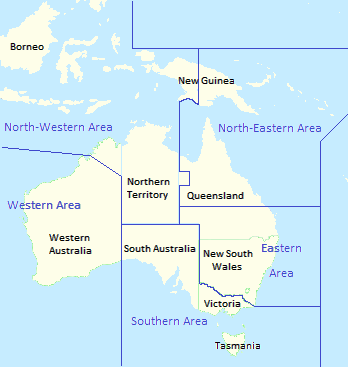
North-Eastern Area Command was one of several geographically based commands raised by the Royal Australian Air Force (RAAF) during World War II. It was formed in January 1942 and controlled units in central and northern Queensland, and Papua New Guinea. Headquartered at Townsville, Queensland, North-Eastern Area Command's responsibilities included air defence, aerial reconnaissance and protection of the sea lanes within its boundaries. Its flying units, equipped with fighters, reconnaissance bombers, dive bombers and transports, took part in the battles of Rabaul, Port Moresby and Milne Bay in 1942, and the landings at Hollandia and Aitape in 1944. The area command continued to operate after the war, but its assets and staffing were much reduced. Its responsibilities were subsumed in February 1954 by the RAAF's new functional commands: Home (operational), Training, and Maintenance Commands. The area headquarters was disbanded in December 1956 and re-formed as Headquarters RAAF Townsville.

Sunday, 16 June 2019

Gallimimus

Gallimimus.
Gallimimus was a theropod dinosaur that lived in what is now Mongolia about 70 million years ago, during the Late Cretaceous. The genus is part of the ostrich dinosaur group of feather-bearing, fast runners. Its head was small and light with large eyes and a bulbous structure at the base of the skull. The snout was longer, broader and more rounded than in similar species. Its horny beak was toothless with a delicate lower jaw. The neck and legs were long, and the weak forelimbs had short three-fingered hands. Several of its fossils were discovered in the Gobi Desert in the 1960s. Gallimimus means "chicken mimic", from the shape of its neck vertebrae. It may have had good vision and intelligence comparable to ratite birds, living in groups as an omnivore, a filter-feeder or a herbivore. Gallimimus was featured in the film Jurassic Park in a scene that included innovative special effects and shaped the popular view of these dinosaurs as bird-like animals.

Saturday, 15 June 2019

Adam Eckfeldt

Adam Eckfeldt.
Adam Eckfeldt (June 15, 1769 – February 6, 1852) was the second chief coiner of the United States Mint. His father owned a large smithy and involved himself in early attempts at American coinage. Eckfeldt built early presses for the Mint, engraved some of its early dies, and was responsible for some designs of early American copper pieces, as well as the 1792 half disme, which some authorities consider the first United States coin. He was appointed assistant coiner of the Mint in 1796, and became chief coiner after his predecessor's death in 1814. During Eckfeldt's tenure, the Philadelphia Mint moved to new premises and expanded its operations. Setting aside unusual coins that were brought in as bullion, he started the Mint's coin cabinet, which evolved into the National Numismatic Collection. Despite his 1839 retirement, Eckfeldt continued performing the duties of chief coiner until his death, though his successor, Franklin Peale, bore the title.

Friday, 14 June 2019

The X-Files

The X-Files.
"Ice" is the eighth episode of the first season of the American science fiction television series The X-Files. Premiering on the Fox network on November 5, 1993, "Ice" was directed by David Nutter (pictured) and written by Glen Morgan and James Wong. The debut was watched by 10 million viewers in 6.2 million households and received largely positive reviews from critics, who praised its tense atmosphere. In the episode, FBI special agents Fox Mulder (David Duchovny) and Dana Scully (Gillian Anderson) investigate the deaths of an isolated Alaskan research team. The agents and their team discover the existence of extraterrestrial parasitic organisms which drive their hosts into impulsive fits of rage. The episode was inspired by an article in Science News about an excavation in Greenland, and series creator Chris Carter also cited John W. Campbell's 1938 novella Who Goes There? as an influence.

Thursday, 13 June 2019

Newberry Volcano

Newberry Volcano.
Newberry Volcano is a large shield-shaped stratovolcano located 35 miles (56 km) east of the major crest of the Cascade Range and about 20 miles (32 km) south of Bend, Oregon, within the Newberry National Volcanic Monument. Considered an active volcano, it is closely monitored with sensors by the United States Geological Survey. Newberry is the largest volcano in the Cascade Volcanic Arc, with a total volume of approximately 120 cubic miles (500 km3) and a caldera (pictured) 4 by 5 miles (6.4 km × 8.0 km) in diameter. It was named for the geologist and surgeon John Strong Newberry, who explored central Oregon for the Pacific Railroad Surveys in 1855. The surrounding area has been inhabited by Native American populations for more than 10,000 years. The volcano and its vicinity include many pyroclastic cones, lava flows, and lava domes, with more than 400 vents, the most of any volcano in the contiguous United States. Newberry Volcano is a popular destination for recreational activities.

Wednesday, 12 June 2019

RSPB Dearne Valley Old Moor

RSPB Dearne Valley Old Moor.
RSPB Dearne Valley Old Moor is an 89-hectare (220-acre) wetlands nature reserve in the Dearne Valley near Barnsley, South Yorkshire, run by the Royal Society for the Protection of Birds (RSPB). It lies on the junction of the A633 and A6195 roads and is bordered by the Trans Pennine Trail long-distance path. Old Moor is managed to benefit bitterns, breeding waders such as lapwings, redshanks and avocets, and wintering golden plovers. Passerine birds include a small colony of tree sparrows and good numbers of willow tits, thriving despite a steep decline elsewhere in the UK. The reserve, along with others nearby, forms part of a landscape-scale project to create wildlife habitat in the Dearne Valley. As of 2018, the reserve had about 100,000 visits per year. It may benefit from future habitat creation beyond the reserve and improved accessibility, although there is also a potential threat from climate change and flooding.