• This is slide 1 description. Go to Edit HTML of your blogger blog. Find these sentences. You can replace these sentences with your own words.
  • This is slide 2 description. Go to Edit HTML of your blogger blog. Find these sentences. You can replace these sentences with your own words.
  • This is slide 3 description. Go to Edit HTML of your blogger blog. Find these sentences. You can replace these sentences with your own words.
  • This is slide 4 description. Go to Edit HTML of your blogger blog. Find these sentences. You can replace these sentences with your own words.
  • This is slide 5 description. Go to Edit HTML of your blogger blog. Find these sentences. You can replace these sentences with your own words.

Friday, 27 March 2020

Introduction to viruses

Introduction to viruses.
A virus is an infectious agent that reproduces inside the cells of living hosts. Unlike most living things, viruses do not have cells that divide; instead they force infected host cells to produce thousands of identical copies of the original virus, at an extraordinary rate. A virus consists of two or three parts: genes, made from either DNA or RNA, long molecules that carry the genetic information; a protein coat that protects the genes; and in some, an envelope of fat that surrounds and protects them when they are not contained within a host cell (and makes them vulnerable to soap). Viruses spread in different ways; some through the air by people when they cough or sneeze, others by the faecal–oral route, and some by direct contact or during sex. Over 4,800 species have been discovered, many of which cause disease in plants and animals, including common human diseases such as the common cold, chickenpox and cold sores, and serious epidemics and pandemics such as HIV, Ebola, influenza, SARS and COVID-19.

Thursday, 26 March 2020

Ubinas

Ubinas.
Ubinas is a stratovolcano in the Moquegua Region of southern Peru, 60 kilometres (37 mi) east of the city of Arequipa. Part of the Central Volcanic Zone of the Andes, it rises 5,672 metres (18,609 ft) above sea level. Its summit is cut by a caldera 1.4 kilometres (0.87 mi) wide and 150 metres (490 ft) deep, which itself contains a smaller crater. Below the summit, Ubinas is a steep cone with a prominent notch on the southern side. The most active volcano in Peru, it has a history of small- to moderate-sized explosive eruptions and persistent degassing and ash emissions. An eruption in 1667, its largest since prehistoric times, produced scoria falls and pyroclastic flows. In 2006 and 2007 eruption columns led to ash fall in the region, resulting in health issues and evacuations. During the most recent activity, from 2013 to 2019, a lava flow formed inside the crater, and as ash fell, surrounding towns had to be evacuated.

Wednesday, 25 March 2020

Megarachne

Megarachne.
Megarachne was a predatory freshwater arthropod of the order of eurypterids, often called sea scorpions. Two fossil specimens of the genus have been discovered, in San Luis, Argentina, in deposits of Late Carboniferous age from the Gzhelian stage. Megarachne ("great spider") was initially misidentified as a spider. With a body length of 54 cm (1.77 ft), it was a medium-sized eurypterid, similar to others within the Mycteropoidea, a rare group known primarily from South Africa and Scotland. The mycteropoids evolved a specialized method of feeding referred to as sweep-feeding, raking through the substrate of riverbeds to capture and eat smaller invertebrates. Due to their fragmentary fossil record and similarities between the genera, Megarachne and two other members of its family, Mycterops and Woodwardopterus, have been hypothesized to represent different developmental stages of a single genus.

Tuesday, 24 March 2020

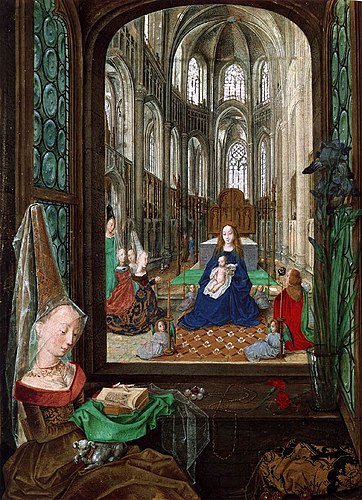
Hours of Mary of Burgundy

Hours of Mary of Burgundy.
The Hours of Mary of Burgundy is a book of hours, a form of devotional book for lay people, completed in Flanders around 1477. It was probably commissioned for Mary of Burgundy, then the wealthiest woman in Europe; Mary was the only child of Charles the Bold, Duke of Burgundy, and wife of Maximilian I, ruler of the Holy Roman Empire. The book contains 187 folios (folio 14v pictured), each measuring 22.5 by 15 centimetres (8.9 in × 5.9 in). It consists of the Roman Liturgy of the Hours, 24 calendar roundels, 20 full-page miniatures and 16 quarter-page format illustrations. It includes meticulously detailed illustrations and borders by the influential illuminator known by the notname of the Master of Mary of Burgundy. Other miniatures, considered of an older tradition, were contributed by Simon Marmion, Willem Vrelant and Lieven van Lathem. The two best-known illustrations contain a revolutionary trompe-l'Å“il technique of showing a second perspective through an open window.