• This is slide 1 description. Go to Edit HTML of your blogger blog. Find these sentences. You can replace these sentences with your own words.
  • This is slide 2 description. Go to Edit HTML of your blogger blog. Find these sentences. You can replace these sentences with your own words.
  • This is slide 3 description. Go to Edit HTML of your blogger blog. Find these sentences. You can replace these sentences with your own words.
  • This is slide 4 description. Go to Edit HTML of your blogger blog. Find these sentences. You can replace these sentences with your own words.
  • This is slide 5 description. Go to Edit HTML of your blogger blog. Find these sentences. You can replace these sentences with your own words.

Friday, 1 January 2021

Armed Forces Special Weapons Project

Armed Forces Special Weapons Project.
The Armed Forces Special Weapons Project (AFSWP) was a United States military agency responsible for those aspects of nuclear weapons that remained under military control after the Manhattan Project was succeeded by the Atomic Energy Commission on 1 January 1947. These included the maintenance, storage, security and handling of nuclear weapons, and support for nuclear weapons testing. Early nuclear weapons were complex and cumbersome, and stored as components rather than complete devices due to the short shelf life of their lead-acid batteries and modulated neutron initiators, and the heat generated by the fissile cores. As nuclear weapons development proceeded, mass-produced models became available that were easier to store, handle, maintain and assemble, and the AFSWP became more involved in stockpile management, and providing administrative, technical and logistical support. In 1958, the AFSWP became the Defense Atomic Support Agency (DASA), a field agency of the Department of Defense.

Thursday, 31 December 2020

George Gosse

George Gosse.
George Gosse (16 February 1912 – 31 December 1964) was an Australian recipient of the George Cross, the highest non-combat award for heroism or courage that could be awarded to a member of the Australian armed forces at the time. Gosse served in the Royal Australian Navy between 1926 and 1933, and in 1940 joined the Royal Australian Naval Volunteer Reserve. He served in the UK before being sent to British India as a naval mine clearance specialist. Returning to the UK in late 1944, in April 1945 he was given command of a party responsible for mine clearance in the recently captured Bremen Harbour in Germany. He displayed courage in defusing three mines under very difficult conditions between 8 May and 19 May 1945, for which he was awarded the George Cross. After the war Gosse reached the rank of lieutenant commander, retiring in 1958. He died of a heart condition in 1964. His medal set is displayed in the Hall of Valour at the Australian War Memorial.

Wednesday, 30 December 2020

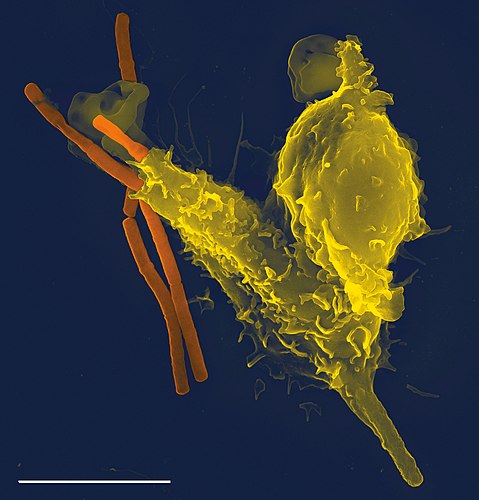
Immune system

Immune system.
The immune system is a network of biological processes that protects an organism against disease. It detects and responds to a wide variety of pathogens, from viruses to parasitic worms, as well as cancer cells and objects such as wood splinters, distinguishing them from the organism's own healthy tissue. Many species have two major subsystems of the immune system. The innate immune system provides a preconfigured response to broad groups of situations and stimuli. The adaptive immune system provides a tailored response to each stimulus by learning to recognize molecules it has previously encountered. Both use molecules and cells to perform their functions. Humans have sophisticated defense mechanisms, including the ability to adapt to recognize pathogens more efficiently. Adaptive (or acquired) immunity creates an immunological memory leading to an enhanced response to subsequent encounters with that same pathogen. This process of acquired immunity is the basis of vaccination.

Tuesday, 29 December 2020

Knap Hill

Knap Hill.
Knap Hill lies on the northern rim of the Vale of Pewsey, in northern Wiltshire, England, about a mile (1.6 km) north of the village of Alton Priors. At the top of the hill is a causewayed enclosure, a form of Neolithic earthwork that appeared in England from about 3700 BC onwards. These earthworks are characterised by the enclosure of an area with ditches that are interrupted by gaps, or causeways. It is not known what they were used for; they may have been settlements, or meeting places, or ritual sites of some kind. Knap Hill was the first causewayed enclosure to be excavated and identified. In 1908 and 1909 Benjamin and Maud Cunnington spent two summers investigating the site, and Maud Cunnington published two reports of their work, noting that there were several gaps in the ditch and bank surrounding the enclosure. The site has been scheduled as an ancient monument. About a thousand causewayed enclosures have now been found in Europe, including around seventy in Britain.