• This is slide 1 description. Go to Edit HTML of your blogger blog. Find these sentences. You can replace these sentences with your own words.
  • This is slide 2 description. Go to Edit HTML of your blogger blog. Find these sentences. You can replace these sentences with your own words.
  • This is slide 3 description. Go to Edit HTML of your blogger blog. Find these sentences. You can replace these sentences with your own words.
  • This is slide 4 description. Go to Edit HTML of your blogger blog. Find these sentences. You can replace these sentences with your own words.
  • This is slide 5 description. Go to Edit HTML of your blogger blog. Find these sentences. You can replace these sentences with your own words.

Tuesday, 19 January 2021

Alexander II Zabinas
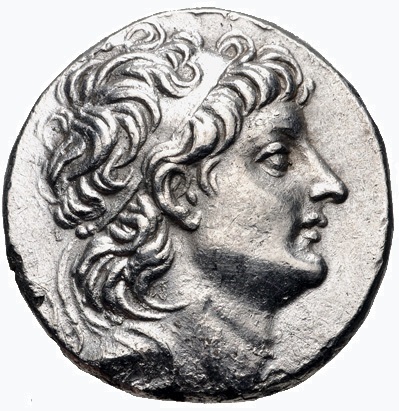
Alexander II Zabinas.
Alexander II Zabinas (c. 150 BC – 123 BC) was a Seleucid monarch of the Hellenistic period who reigned as King of Syria between 128 BC and 123 BC. Most historians, ancient and modern, maintain that he was a pretender to the throne, although his coinage suggests that he claimed descent from Antiochus IV (died 164 BC), the brother of King Seleucus IV (died 175 BC). Descendants of both brothers were contending for the throne. In 128 BC, King Demetrius II of Syria, the representative of Seleucus IV's line, invaded Egypt to support his mother-in-law Cleopatra II in a civil war. Demetrius was killed while trying to find refuge in the city of Tyre, and Alexander II became the master of the kingdom. Egypt's Ptolemy VIII did not want a strong king on the Syrian throne, and in 124 BC an alliance was established between Egypt and Cleopatra Thea, ruling jointly with Antiochus VIII, her son by Demetrius II. Alexander II was defeated and was probably executed by Antiochus VIII.

Monday, 18 January 2021

Porlock Stone Circle

Porlock Stone Circle.
Porlock Stone Circle, on Exmoor in the south-western English county of Somerset, is part of a tradition of stone circle construction that spread throughout much of Britain, Ireland, and Brittany during the Late Neolithic and Early Bronze Age between 3,300 and 900 BCE. The purpose of such monuments is unknown, although archaeologists speculate that the stones represented supernatural entities for the circles' builders. Many monuments were built in Exmoor during the Bronze Age, but the only other surviving stone circle in the area is the one near Withypool. The circle near Porlock is about 24 metres (79 feet) in diameter and has thirteen green micaceous sandstone rocks. Directly to the north-east of the ring is a cairn apparently connected to a linear stone row. A small lead wheel inside the circle suggests that the site was visited during the Romano-British period. The site was rediscovered in the 1920s.

Sunday, 17 January 2021

Elizabeth Willing Powel

Elizabeth Willing Powel.
Elizabeth Willing Powel (February 21, 1743 – January 17, 1830) was an American socialite and a prominent member of the Philadelphia upper class of the late 18th and early 19th centuries. After the American Revolutionary War, she established a salon of the Republican Court of leading intellectuals and political figures. She corresponded widely, including with the political elite of the time. A close friend to George Washington, she was among those who convinced him to continue for a second term as president. She wrote extensively, but privately, on a wide range of subjects, including politics, the role of women, medicine, education, and philosophy. Powel is said to be the person who asked Benjamin Franklin "What have we got, a republic or a monarchy?", to which he replied "A republic ... if you can keep it"; over time the role played by Powel in this exchange has been all but removed. Hundreds of her letters and several of her portraits survive.

Saturday, 16 January 2021

John C. Breckinridge

John C. Breckinridge.
John C. Breckinridge (January 16, 1821 – May 17, 1875) was an American lawyer, politician, and soldier. He represented Kentucky in both houses of Congress and became the youngest-ever vice president of the United States. He was elected to the House of Representatives in 1850 as a Democrat. He served as vice president from 1857 to 1861 alongside President James Buchanan. In 1859, he was elected senator for Kentucky. The Southern Democrats held two rival conventions; one nominated Breckinridge for president, who carried most of the Southern states. With the southern vote split, Abraham Lincoln won the election. Taking his Senate seat, Breckinridge urged compromise. When the Civil War broke out, Breckinridge fled to the Confederacy. He fought in numerous engagements as a general officer. In 1865 he was appointed secretary of war and urged the Confederate president, Jefferson Davis, to arrange a national surrender. After the war he lived abroad, returning in 1869.