• This is slide 1 description. Go to Edit HTML of your blogger blog. Find these sentences. You can replace these sentences with your own words.
  • This is slide 2 description. Go to Edit HTML of your blogger blog. Find these sentences. You can replace these sentences with your own words.
  • This is slide 3 description. Go to Edit HTML of your blogger blog. Find these sentences. You can replace these sentences with your own words.
  • This is slide 4 description. Go to Edit HTML of your blogger blog. Find these sentences. You can replace these sentences with your own words.
  • This is slide 5 description. Go to Edit HTML of your blogger blog. Find these sentences. You can replace these sentences with your own words.

Saturday, 13 February 2021

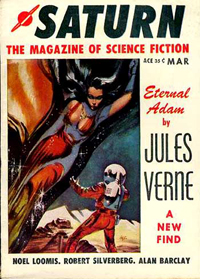
Saturn (magazine)

Saturn (magazine).
Saturn was an American magazine published from 1957 to 1965. It was launched as a science-fiction magazine, but sales were weak, and after five issues the publisher, Robert C. Sproul, switched the magazine to hardboiled detective fiction that emphasized sex and sadism. Sproul renamed the magazine several times, settling on Web Terror Stories in 1962, and the contents became mostly weird-menace tales—a genre in which apparently supernatural powers are revealed to have a logical explanation at the end of the story. Donald A. Wollheim was the editor for the first five issues; he published material by several well-known authors, including Robert A. Heinlein, H. P. Lovecraft, and Harlan Ellison, but was given a low budget and could not always find good-quality stories. It is not known who edited the magazine after the science fiction issues, but themes of violence, torture and sex continued to the end of the magazine's run. Sproul finally cancelled the title in 1965 after a total of 27 issues.

Friday, 12 February 2021

Grant Memorial coinage

Grant Memorial coinage.
The Grant Memorial gold dollar and silver half dollar were struck by the United States Bureau of the Mint in 1922 in honor of the 100th anniversary of the birth of Ulysses S. Grant, a leading Union general during the Civil War and later the 18th president of the United States. The two coins are identical in design and were sculpted by Laura Gardin Fraser. The Ulysses S. Grant Centenary Memorial Association wanted to sell 200,000 gold dollars to pay for projects in the areas of Grant's birthplace and boyhood home. Congress authorized 250,000 half dollars, but only 10,000 gold dollars. About 5,000 of each denomination were struck with a special mark, a star (example pictured). All of the gold dollars and most of the half dollars sold. The half dollar with star has long been priced higher than most commemoratives; its rarity has also caused it to be counterfeited. Money from the coins was used to help preserve Grant's birthplace, but other planned projects were not completed.

Thursday, 11 February 2021

Bernard A. Maguire

Bernard A. Maguire.
Bernard A. Maguire (February 11, 1818 – April 26, 1886) was a Catholic priest and Jesuit who twice served as the president of Georgetown University. Maguire emigrated with his family from Ireland to Maryland at the age of six, where he studied under the Jesuits at Saint John's College, and entered the Society of Jesus in 1837. He then continued his education at Georgetown University, where he eventually became a teacher and prefect. As prefect, Maguire was responsible for quelling an uprising of 40 students who were unhappy with rules over the meeting times of the Philodemic Society. In 1852, he became the president of Georgetown University, and oversaw the partial separation of the preparatory division from the college. He left in 1858 to do pastoral work, but returned as president in 1866. Maguire directed the university's rebuilding after the Civil War and the establishment of the law school. His tenure ended in 1870, and he spent the rest of his life in pastoral ministry.

Wednesday, 10 February 2021

Operation PBHistory

Operation PBHistory.
Operation PBHistory was a covert operation carried out in Guatemala by the United States Central Intelligence Agency. It followed Operation PBSuccess, which led to the overthrow of Guatemalan president Jacobo Árbenz (pictured) in June 1954 and ended the Guatemalan Revolution. PBHistory attempted to use documents left behind by Árbenz's government, police agencies, trade unions and the communist Guatemalan Party of Labour to demonstrate that the Guatemalan government had been under the influence of the Soviet Union. The documents uncovered by the operation proved useful to the Guatemalan intelligence agencies, enabling the creation of a register of suspected communists. The operation did not find evidence that the Guatemalan communists were controlled by the Soviet government, and could not counter the narrative that the United States had toppled the Árbenz government to serve the interests of the United Fruit Company.